Showing posts with label acorns. Show all posts

Monday, April 12, 2010

Group Mind, Survival Day 3


We awoke at dawn of course, but few stirred from their fires. I curled by my coal bed, now white with ash, and listened to song sparrows and other greeters of the dawn.

Some of us were still up and moving, though -- notably the man who'd tended all our fires. He looked the most pleased of any of us to be sitting in that campsite that morning.


Then a stream of cursing jolted me fully awake - one of our German cohorts, a fellow with a fondness for foul language, was sitting bolt upright and patting out imaginary flames on his jacket sleeve. As he woke fully from his dream of burning cloth, he looked across the fire to another Native Eyes student. She had been awakened by his blue streak of curses, and now sat upright as well, staring at the charring, glowing hole, a hand's breadth wide, that her fire had opened in her sweater sleeve.

Later we realized that, though we remembered to bring our minds together in thanksgiving at every oportunity, we forgot to separate them.
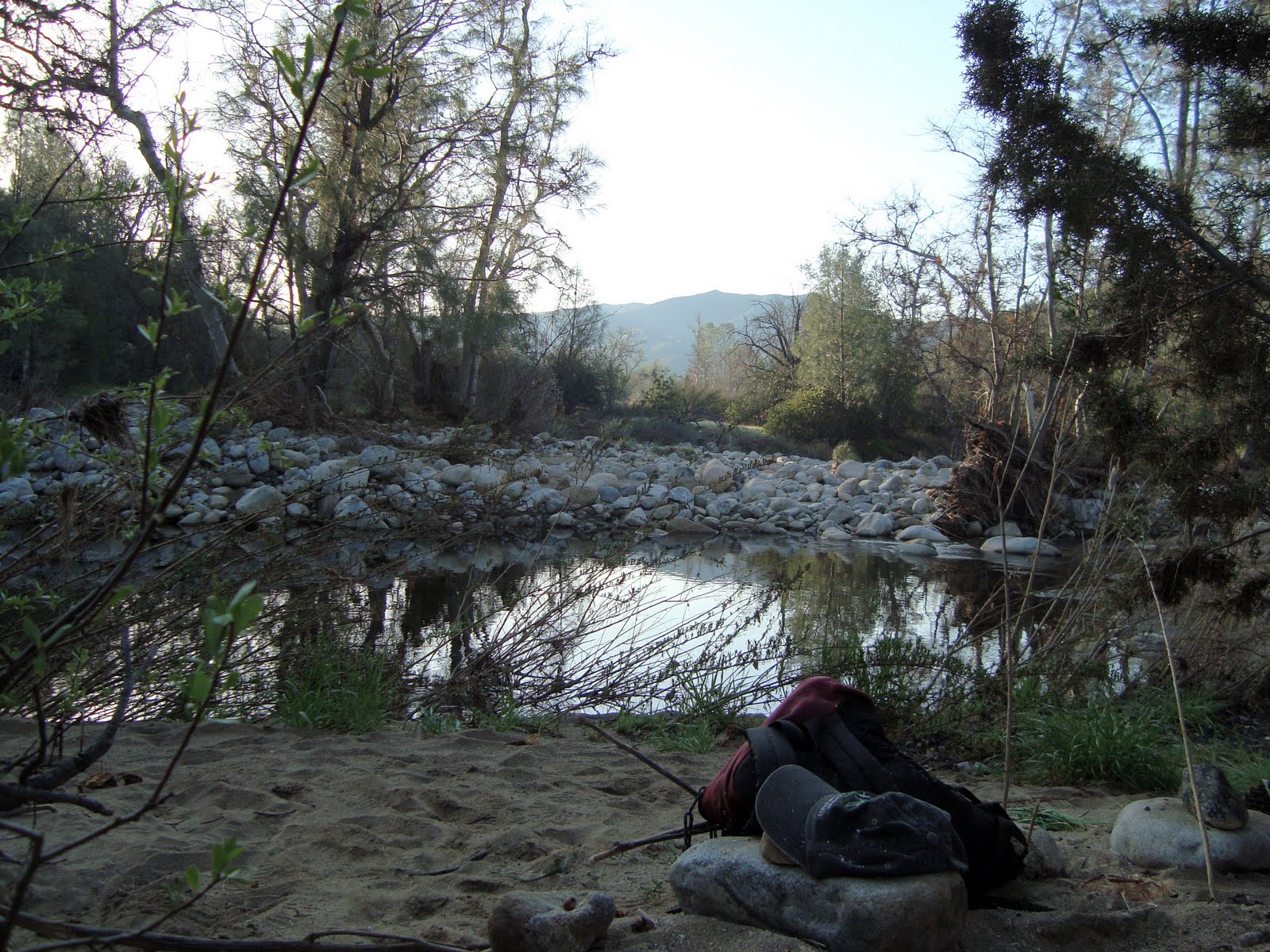

We lazed and dawdled until someone went down to the creek to taste the acorn. When they came back, bag dripping and full of what we could finally call food, everyone began to move. We revived two of the night's fires, found some good flat-ish rocks, and began stoking.


One fire had lots of coals. On this we heated rocks that were about a quarter of an inch thick. We tested the heat of the rock by licking a finger and touching the surface -- if it sizzled, it was ready. We squeezed most of the water out of the acorn and plastered in on to the hot rocks. Soon the acorn turned dark and the edges of the acorn cracker peeled up. Then we flipped the crackers to cook out the water from the other side. This method was fast, but required constant fire to make more coals. The rocks didn't hold much heat.


At the other fire, we had found some bigger, bulkier rocks. We set up a sort of tripod of tall rocks around the center of the fire and placed our fairly bulky flat rock on top, over the center of the fire. Then we stoked the fire high to heat the mass of the rock. This setup took much more time to get started, but held heat for much longer than the small flat rock setup.

Both fires cranked out acorn crackers for the whole morning. The crackers themselves tasted bland at first -- which is saying a lot, since we were three days hungry by now. But chewing them for a while brought out a lovely nutty sweetness.

As we cooked, stoked the fire, and munched, we also talked. We discussed the year so far, and asked the question, "how can we make the rest of this year of Native Eyes as amazing as we need it to be?"


One of our companions who was not part of the entire Native Eyes year and would be leaving after the survival trip, had wandered off around dawn to find a sit spot. All through breakfast and lunch (the two kind of blended into each other) we were involved with our Native Eyes conversation. The topic didn't concern our absent companion, so we weren't concerned that he was missing the discussion. We saved his portion and kept talking into midday. Then, as the energy wound down around our topic, we realized that he had been gone for many hours. One of us said he would go holler for the wanderer, but got involved again in the last words on the Native Eyes subject, so no one sent out a call.

After we said the final words in our discussion, and all were ready to move on, we looked up to see our wandering friend walking into our camp.


With the bag of acorn empty of even the finest crumbs, our conversation played out, and our companion returned, we needed something to do with all the acorn-energy. We decided to finally do some exploring and move camp. We had our bowless fire drill kit still assembled, but we didn't want to have to spin up another coal that evening. So we gathered punky chunks of wood from the downed pines. Some, about as long as my arm, we used whole. We pushed one end of the punk sticks into the fire to catch a coal, then walked with that end up and out of the wind. It smoldered well until the wind came up and set the punk sticks flaming.

The smaller chunks of punky wood I ground to powder on our acorn grinding stones. I found some long concave chunks of bark and lined them with cattail fluff. Then I poured the punky wood powder over the cattail fluff, taco'd the powder in fluff, and surrounded the whole thing with a layer of bark. I stuffed a live coal in one end and tied the bark tight to restrict air flow. We carried our fire with us.


Our wander spread us out over the land. With no trail and only springy grass to take a track (actually the grass took a track pretty well, but didn't hold it for long), we kept in contact with raven calls.

Finally, we found it. The place. THE place to spend the night. A minute, narrow valley between the two masses of sandstone that sat in the grass like giant rounded loaves of dough. It was sheltered from the night winds and within an easy walk of two downed valley oaks for firewood. Dead manzanitas, too, were scattered on the sandstone. It even had water, though not the fast-flowing crystalline creek that we'd slept by previously.


After resting at the new site for some time, Team Ground Squirrel decided that we'd like to go check our traps. We took a circuitous route to admire the scenery and look for more food on the way.


When we found this beautiful pond turtle neither of us could even consider taking him back to camp for dinner. For all that his kind are our native testudine, I'd never seen one this close, and rarely seen them at all. I've only gotten this close to the pet shop kind of turtle, red-eared sliders. We admired the gold glint and patterning on his skin, and in his eyes, before leaving him in peace.


More spectacular landscape brought us back to the ground squirrel meadow, where we found trap after trap disturbed but unoccupied. Perhaps the nooses were too large, or too noticeable?


With the light taking on the gold of afternoon, both my companion and I felt the magnetism of the sun-warmed earth. We lay in the grass to rest, and my companion began to snore. I relaxed into the ground and dreamed.

When I awoke, I awoke fully and completely. I sat up, feeling refreshed, and said something to my companion. He replied that he had just woken up too and was ready to move on. We stood up and saw another Native Eyes student approaching from the direction of camp. We joined him on his walk to the creek.

Why did we both feel the overwhelming, bone-deep need for a nap at that time? Why did we both snap awake in such synchrony? If we had been asleep when the other Native Eyes person came down, would he have been able to notice us, flat out in the grass?


We returned to camp with our empty nooses and set to gathering firewood. We had two gargantuan piles by dusk, one of manzanita and one of oak. We would sleep warm.

We gathered around our fire after the last light had gone. We gave thanks for the journey we were on, and checked in with everyone. Then we settled ourselves around two fires for the night.


Before we slept we also experimented with a self-feeding fire technique from YouTube. We found that manzanita and weathered oak burn too thoroughly and too quickly. The tower of wood that, according to the video, should have taken hours to burn down took about thirty minutes. But it was spectacular.


Saturday, April 10, 2010

Msafiri Time, Survival Day 2


At dawn I found myself soggy from the steam. I stripped off my warm clothes, laid them where the sun would soon warm them, curled myself by the fire and fell asleep again. We awoke in fits and starts that morning and the sun was high before all of us were on our feet.

I'd had a nauseating and head-splitting migraine in the night. A salt packet in my water and some aspirin from the first aid kit finally cut through the most acute pain, but I still felt sluggish and ill from mild hyponatremia (a good reason to pack salt in your first aid kit on multi-day wilderness trips, especially if fasting is involved). Still, I wanted to find a new campsite for the night.


One of the other participants kept talking about his adventures walking up a similar creek and finding trout in the shadows and backwaters of undercut banks. The day was warm and I wanted to go upstream anyway, so I decided that my willow walking stick would become a fish spear instead. I split the end, sharpened the tines, wedged in two small sticks, and made some dogbane cordage to keep the splits from opening too wide. The whole process took about thirty minutes. And then, with spear in hand and sun warm on my shoulders -- I took a nap on the sandbar. I was exhausted by the work of making a simple fish spear.


As I snoozed others were cracking acorns and grinding them to a coarse, bitter flour. The rhythm of pounding stones and cracking shells drifted me to deeper sleep.


We found that some of the acorns from a particular Valley Oak tree on the Peninsula had exceptionally little tannin and had been dried in a too-hot oven. They turned out to be slow-roasted, sweet, and only very slightly tannic. We roasted them further in the fire to soften them and turn more starches to sugars, and ate them out of hand as we pounded the bitter acorns to flour.

I slept into the afternoon. After drinking small amounts of lightly-salted water all day I at least felt ambulatory, and had some appetite for the roasted acorns. My stomach told me in no uncertain terms, though that only a few of the roasted un-leached acorns would be acceptable.


By afternoon, my eagerness to explore finally outweighed my sluggishness. Another participant was just leaving to set some snares for ground squirrels, and I decided to come along. He had brought some lengths of wire twisted into nooses.

We knew we'd arrived at a good ground squirrel meadow for a number of reasons. The grass was crisscrossed with runs to and from large round holes, some holes dipping diagonally into bare earth mounds and some straight down into the grassy meadow. The squirrels themselves scattered and dropped into these burrows when we approached. And now and then a beeping alarm would sound from an unseen sentry at a burrow.

We scanned the horizon for golden eagles as we worked, wondering if the more distant flicker and squirrel alarms together meant that an eagle was approaching. We set something like eight or ten traps in all, dangling a loop over a run or over a burrow. We staked the wires in the ground, and hoped that the headlong rush of squirrels bolting for their holes would cinch the snares.


I was still so dazed and low energy from fasting that halfway through the snare expedition I forgot where we'd already set the snares. I had trouble pounding in stakes. I started to get angry at the world for letting me get so hungry, tired and ill. I wanted to just stop and lie in the grass until someone took care of me.

Then I remembered something one of my mentors liked to say about the "sacred order of survival." Everyone has a different order to these four necessities, depending on season and environment: shelter, water, fire, food. Sometimes, as in our case, fire can be your shelter. Or it can be your source of clean water. Sometimes a debris hut will save your life. But in all cases, my mentor listed a fifth necessity for survival: attitude. The will to what you need to do, to survive or thrive. And my mentor put this requirement before all else.

Before this trip I thought that fifth, really first, requirement, was a no-brainer. What living being could be so out of the flow of life that it lacks the will to live? It turned out that I might. I wanted to give up all efforts to find firewood, filter water, find food, and make camp. I wanted to lie on the ground until someone else took care of me, made me warm, fed me good hot food.

I took stock of myself: almost to the point of tears with anger at not being taken care of, not having my needs met. And I understood that if my friends weren't there, or were not as skilled as they are, that attitude could possibly have me dying of chronic hypothermia in another few days. And others in the group were also relying on me to keep myself together and support them if they were to break down as I just did.

This whole thought process took no more time than a pause in pounding in the stake. I sat up again and kept pounding.


After our afternoon nap, we began the walk back to camp. On the way we found some Blue Dicks flowers, and my companion showed me how to ID the flower (a tight cluster of blue six-petaled tubular flowers at the top of a long stalk with two long narrow leaves, folded acutely along the midrib, attached at the base), dig deep with a digging stick, and follow the long, delicate, subterranean stem of the flower to the corm. The corm turned out to be about half the size of a marble, with little cormlets clinging to the side. We broke off the baby corms and the root crown (a part at the bottom of the corm that resembles the root end of an onion, and breaks easily from the main corm) and replanted them in the turned earth. Then I ate the corm whole and raw.

Important note: If anyone is planning to eat Blue Dicks, please first consult an expert in plant ID and make sure your specimen is flowering. There are deadly bulb- and corm-bearing wildflowers in California. Please also know the laws concerning gathering wild plants in your area.

The little mouthful of living carbohydrate energy transformed my worldview. Where before, maintaining a positive attitude was a Herculean feat, now my energy buoyed up on its own. Though there weren't any more diggable Blue Dicks, I dug nine more thistles for our evening meal, and walked back with more energy and enthusiasm than I'd felt since before the first morning.


Back at camp the acorn-pounders, after submerging the bag of acorn meal in the creek for the night, had become wood gatherers. Team Ground Squirrel lent a hand gathering dead wood, and soon we had a veritable beaver dam of dry wood on our sandbar. After long discussion, we arrived at a plan for the night: four fires, one for every two people, arranged in a square on the sand. Everyone would lie in a radial pattern with feet to the center and fires between pairs of people. Space constraints kept the plan from working quite as it was sketched, so we wound up with five fires for the night. Our intention was to tend each fire individually, with people waking as their fires went cold and adding more wood as needed. We snuggled up to our little blazes and went to sleep.


But almost no one woke up that night. One person, his fire awareness honed by years of solo camping with no sleeping bag, woke up to add wood to his fire. As he reached behind him into the wood pile, a hand came down in front of him, holding the very piece of wood he had reached for, and placed it in the exact spot he intended. Our eldest Native Eyes student had decided to stay up all night and tend all five fires for us as we slept.


We slept sound and warm through that night.

Monday, October 26, 2009

Kitchen Wisdom


We began the session with the usual wander for cougar sign. None found, as far as we could tell. We tracked eachother, the returning winter birds, the warm pools of Indian Summer sun, and the new wild radish sprouts that follow the early rain.

Back at camp, we met Matt Berry and his collection of pots made from wild-harvested clay. We were going to do the same, to have some communal kitchenware appropriate to our rustic open-fire setting. We began by digging the clay from the ground just twenty feet from our fire, and mixed it with sand (grog).


We mixed the clay by foot and by hand.


The pots were big communal affairs, with some people pinch-pot molding the pointed bottoms, some people rolling "snakes" to make coils, and some people building up the coils into pots. All were absorbed in the work, even the junior contingent. We grudgingly set asid our creations when dinnertime rolled around, to be finished at a later date.

A highlight from the next day was Matt's wild foods walk. All plant uses listed here are my off-the-top-of-my-head recollections. If you're looking to use wild plants, take one of Matt's or another experienced instructor's classes yourself, and start studying some reputable books. One not listed at that link, that might be a good starting point, is the Peterson guide to Venomous Animals and Poisonous Plants. Learn what'll kill you before (or at the same time as) learning what'll nourish you.


One of the first and most nutritious gifts of the season that we encountered were new green Stinging Nettles (Urtica dioica) sprouting by the creek. These are even edible raw if you roll the leaf so that the hairs (on the underside) face in.


Cow Parsnip (Heracleum maximum) is a common, moisture-loving native. The skin can have phytotoxins that can cause severe sunburn, but peeled stalks have been called "Indian celery."


Dock (Rumex crispus) was present as a dry stalk and seedhead, and as fresh young growth at the base of the dead stalk. The seeds are edible and are like miniature buckwheat kernels. Toasting (also known as "parching") or soaking them may utilize the seeds to best effect.


Dock leaves are rediculously high in oxalic acid, but can be boild in a change or two of water to make them more tasty. A relative, Sheep Sorrel (Rumex acetosella) makes delicious sour accents in salads. The deep, hardy, woody and yellow root is a traditional and powerful remedy for liver deficiencies and related skin problems.


Radish (Raphanus sativus) was not only springing up as new succulent sprouts. In dry places, the old woody ones still dispersed the peppery seed or stood skeletal and moldering. In some shady spots the plants were in flower (my personal favorite way to eat wild radish is to bite the flowers straight off the plant), while in others the freshly immature, spicy seed pods hung. Still other wet spots had young plants yet to flower. Radish seems to be the master of the microclimate.


Broadleaf Plantain (Plantago major) was in seed near the veggie garden. It's leaves and seeds are edible. It's also good soothing medicine for bee stings. Its cousin, Narrowleaf Plantain (P. lanceolata) is even more medicinal than edible, being very good at drawing out toxins when poulticed on a sting or insect bite.


Beaked Hazelnuts (Corylus cornuta) are not really in season now, having ripened and largely been devoured by squirrels back in mid- to late-summer. But they get a pass because they photographed so nicely.


Manzanita (Arctostaphylos spp.) berries are ending their season, but some bushes still carry the tangy, dry, powdery fruits. Crush lots of the berries in cold or hot water, strain it, and impress your friends with one of the most delicious wild ciders around.


Madrone (Arbutus menziesii) trees have started to drop their bright red berries, shown here with the big, broad, leathery leaves as well. The berries are edible and tasty raw -- I usually just nibble the flesh off the stony core. The tall trees are most noticeable from the forest floor not by their leaves or berries, but by their bark. The big ones have blocky, chunky, craggy bark on the main trunk, papery peeling wine-colored outer bark on the limbs, and sunset-gold inner bark that shines beautifully in the light. They also feel cold to the touch.

Toyons (Heteromeles arbutifolia) also have fruit lately, but I haven't seen it ripe yet. It's a shrub, represented here by it's green oblong berries and smaller toothed leaves. I've never eaten the berries, though multiple friends and teachers have said they're edible. I've heard they're good if wilted over a fire first.


And here we have Bay (Umbellularia californica) nuts, the second biggest mast crop of the season. They're shown here both fresh and roasted. They're inedible raw, and must be roasted to volatilize off some of the more noxious bay oils. Even roasted, they're strong stuff. The nuts have a chocolate-like flavor, are very high in fat, and can be ground up in a mortar and mixed with sugar for a very chocolate-like effect. But this stuff is far more of a digestive and vascular stimulant than is chocolate. Overconsumption has been known to cause effects as diversely unpleasant as trembling muscles, migraine headaches or explosive diarrhea. I've also accidentally absorbed the stimulant through my skin while cooking with the ground-up nuts, giving myself a much higher dose than I'd planned and getting none of the lovely bay flavor to justify my jitters. Though delicious, bay commands respect, patience, and careful self-observation in it's use.


The biggest and most important wild crop is of course acorns. Lots of the oaks near me have already passed their buggy first drop and are in full swing of their mind-bogglingly plentiful second drop. Acorns everywhere! I wish I had more oven racks to dry more acorns on. These here are Valley Oak (Quercus lobata), a low-tannic-acid starchy acorn in the white oak lineage. The jar in the background holds Black Oak (Quercus kelloggii), a high-tannic-acid oily acorn in the red oak lineage. One must of course wash out the tannic acid before eating acorns, as tannin can be toxic in high doses.


Finally, an early crop of Miner's Lettuce (Claytonia perfoliata)! The young leaves look much more like grass blades or chickweed (Stellaria media) leaves (and taste a lot like chickweed, too) than like the commonly recognized round leaves of the mature plant. Yum!

Sunday, September 20, 2009

natural events log

Some interesting things have happened recently, that I thought worthy of a little post.

First, we had the first rain of the season, a very early, bombastic and drenching thunderstorm on the night of my birthday. It may have even been thundering and flashing lightning at the very hour I was born. Kinda cool. I think this is the earliest and biggest fall storm I can remember. Here's to hoping for an early and quenching rainy season.

Second, the Live Oak acorns in the East Bay cities started dropping last week! Huddart Park on the Peninsula is also starting their Live Oak and Blue Oak acorn drop. And I found a single, fat, fuzzy Tan Oak acorn. It was whole, and unmarred, without even a wevil hole. Yay acorns!